

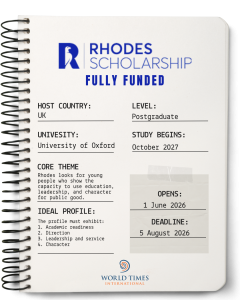
The Rhodes Scholarship is one of the world’s most prestigious postgraduate scholarships for study at the University of Oxford. The scholarship covers Oxford course fees and provides an annual stipend, with the 2025–26 stipend listed by Rhodes as £20,400 per year. It is fully funded, but it is not only about funding. Rhodes looks for academic excellence, leadership, character, service, and a clear sense of purpose.
At World Times International, our expert team includes mentors who have won prestigious international scholarships themselves. We do not guide students through borrowed information or generic online data. We guide through experience, profile insight, and a real understanding of what competitive scholarship applications demand.
Here is what you need to know about the Rhodes Scholarship 2027:

1. Eligibility is only the first filter
Meeting the age, nationality, academic, and degree requirements does not make someone competitive. It only means they can apply. For Pakistan, the number of awards is extremely limited, so a student must think beyond eligibility and assess whether their profile has national-level distinction.
2. Your Oxford course choice matters deeply
Rhodes is for postgraduate study at Oxford, and candidates must check whether their proposed course is covered by the scholarship. A weak or random course choice can damage the application because it suggests the student is chasing Oxford rather than pursuing a serious academic plan.
3. Academic excellence is essential, but not enough
Rhodes selection criteria include academic excellence, but they also include energy to use one’s talents fully, truth, courage, devotion to duty, sympathy for the weak, kindliness, unselfishness, fellowship, moral force of character, and leadership instinct. A high GPA without purpose, service, or leadership depth will not feel complete.
4. The personal statement is not a generic SOP
A Rhodes personal statement must sound deeply personal, mature, and honest. It should not simply say, “I want to study at Oxford because it is prestigious.” It should reveal the applicant’s values, choices, growth, leadership, service, and future direction.
5. Your referees can strengthen or weaken the application
Rhodes requires strong references. Students should choose people who know their academic ability, character, leadership, and service in detail. A famous referee who writes vaguely is weaker than a serious mentor who can give evidence.
6. Rhodes is best for students with a coherent story
A strong application should connect past work, academic interests, leadership, service, Oxford course choice, and future impact. A scattered profile with many activities but no clear direction can look weaker than a focused profile with depth.

1. You must be Pakistani
You must be a citizen of Pakistan and hold a Pakistani passport.
2. You must meet the Pakistan education/residency condition
You should have studied at an educational institution in Pakistan for at least 4 of the last 10 years, along with the Pakistan-specific education conditions given by Rhodes.
3. You must meet the age requirement
Most applicants must be 18 to 23 years old on 1 October 2026.
This means you must be born after 1 October 2002 and before 2 October 2008.
4. You must have, or be completing, an undergraduate degree
You must have completed your undergraduate degree, or be on track to complete it before starting at Oxford in October 2027.
5. Your academics must be strong enough for Oxford
Rhodes mentions that candidates have a stronger chance of admission to Oxford if they have a First Class Honours degree or equivalent, or around 3.70/4.00 GPA or higher.
6. Your course must be eligible
Rhodes is for full-time postgraduate study at Oxford. Most full-time postgraduate courses are eligible, but students must check whether their chosen Oxford course is covered under Rhodes conditions.
7. You must meet English language/course requirements
If English is not your first language, you may need to meet Oxford’s English language requirements for your selected course.

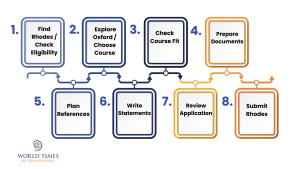
1. You apply for the Rhodes Scholarship first
For Rhodes, the process is slightly different from many university scholarships.
You do not simply apply to Oxford first and then search for funding later. For the Rhodes Scholarship, candidates submit the Rhodes application first. If selected, they then apply to their chosen Oxford postgraduate course with support from Rhodes House.
2. Check whether your subject is eligible
Before writing the application, students must check whether their intended Oxford course is covered under the Rhodes conditions of tenure.
Most full-time postgraduate courses at Oxford are eligible, but not every course combination may be allowed. Some courses may have special rules, duration limits, or funding conditions.
3. Course choice is part of your application story
Rhodes selectors want to see that your course choice makes sense.
A random course weakens the application, even if the student has good grades. Your chosen Oxford course should connect clearly with your previous education, your work or interests, and the impact you want to create in the future.
4. Selection for Rhodes does not automatically mean Oxford admission
This is a very important point.
Being selected as a Rhodes Scholar does not automatically guarantee admission to Oxford. Selected candidates still need to secure admission into their chosen Oxford graduate programme. Rhodes can support your Oxford application process, but Oxford admission remains a separate academic requirement.
5. Start with eligibility, then move to competitiveness
Many students stop at eligibility.
They ask:
“Can I apply?”
But for Rhodes, the better question is:
“Can I compete?”
Eligibility means you are allowed to submit an application. Competitiveness means your profile has the academic strength, leadership evidence, service record, character, maturity, and clarity of purpose required to stand out.
6. The application is built in layers
A Rhodes application is not one document. It is a complete profile.
Students usually need to prepare:
Academic records
CV
Oxford course choices
Personal statement
Academic statement
References
Eligibility documents
Proof of identity
Interview preparation, if shortlisted
7. References should be planned early
References are not a last-minute formality.
Students should contact referees early, explain the scholarship, share their academic plans, and give them enough time to write thoughtful letters.
8. The personal statement must show the person behind the profile
The Rhodes personal statement should not read like a standard SOP.
It should show who the applicant is, what shaped them, what they value, how they have used their abilities, and what kind of contribution they hope to make.
It should not sound over-polished, exaggerated, or copied from scholarship templates.
9. The academic statement must show study direction
The academic statement is where the student explains the Oxford study plan.
It should show:
What they want to study
Why this course matters
How their background prepares them
Why Oxford is the right place
How this study connects with future impact
This section must be precise.
10. Do not wait for the deadline
The deadline should not be treated as the day to complete the application.
It should be treated as the day everything is already finished.
By the final week, students should ideally have:
Final course choices
Completed statements
Uploaded documents
Confirmed references
Reviewed CV
Checked eligibility
Prepared for possible next steps
Rhodes is not an application students should rush. It is an application they should build carefully.
Not being shortlisted does not automatically mean the profile is weak. Rhodes is extremely selective, especially in a constituency with only two awards. Students should treat the process as both an opportunity and a serious learning experience.
Deadline 5th August, 2026

Public Policy, International Relations, Development Studies
Do not simply say you want to “serve Pakistan.” Show the specific problem you care about, such as education reform, governance, climate adaptation, public finance, gender, health systems, migration, or institutional reform. Rhodes will value clarity of public purpose, but vague patriotism will not be enough.
Law
Show more than interest in justice. Connect your legal interests to real questions: constitutionalism, human rights, climate law, trade law, technology regulation, gender justice, refugee law, or public accountability. Your application should show legal reasoning and public responsibility.
Economics and Finance
Avoid making the application sound like a career move only. Link economics to public problems, such as inequality, debt, development, energy markets, taxation, financial inclusion, or climate finance. Rhodes will respond better to economic thinking that connects markets with society.
IT, Data Science, AI and Computer Science
Do not present technical skills alone. Show how technology can solve real problems. Strong angles include AI for education, public health data, climate analytics, ethical AI, digital governance, cybersecurity, financial inclusion, or civic technology. Rhodes will ask what your technology is for, not just what you can build.
English, Literature, Media and Humanities
Do not underestimate this field. Rhodes is very compatible with humanities if the applicant can show intellectual depth, cultural awareness, writing strength, and social relevance. Strong angles include language and power, postcolonial identity, media ethics, education, public storytelling, cultural memory, gender, migration, and representation.
Science and Research Fields
Show research seriousness and wider value. Whether biology, chemistry, physics, environmental science, or biomedical research, connect your work to a larger problem. This may include public health, climate resilience, clean energy, food security, disease, materials innovation, or science policy.
Medicine and Public Health
Do not only list clinical ambition. Show concern for systems, access, equity, prevention, community health, health policy, or research. Rhodes will value applicants who can connect medicine with society, not only personal career prestige.
Climate, Energy and Environment
This is a strong fit if the applicant can show both technical understanding and social relevance. Good directions include energy transitions, water stress, air pollution, climate adaptation, just transition, disaster resilience, biodiversity, or Global South climate finance.
Education
This can be powerful if framed beyond “I like teaching.” Strong applicants should show concern for learning outcomes, access, curriculum, assessment, EdTech, teacher training, girls’ education, or education policy. Personal tutoring experience should be connected to a larger education challenge.
Business, Management and Entrepreneurship
Be careful. Rhodes is not looking for business ambition alone. The application should show how enterprise connects with social value, innovation, employment, inclusion, sustainability, or public problem-solving. A startup story should show responsibility, not just growth.
Engineering
Show how engineering solves human problems. Strong angles include infrastructure, water, transport, renewable energy, climate-resilient cities, biomedical devices, public systems, or low-cost technology for underserved communities.
Arts, Culture and Creative Fields
This can work if the applicant shows excellence, originality, and social meaning. Connect creative work to identity, public dialogue, cultural preservation, education, community engagement, or social change. The portfolio or achievements should support the story.
https://www.rhodeshouse.ox.ac.uk/scholarships/applications/
1. Treating Rhodes like a grades-only scholarship
Strong academics matter, but Rhodes also looks for leadership, service, character, and purpose.2. Writing a generic personal statement
Do not just list achievements. Show your story, values, direction, and the impact you want to create.3. Choosing Oxford courses without clear logic
Your course choice should connect with your background, future goals, and larger contribution.


For Rhodes, students need more than application filling. They need course-fit analysis, profile judgment, leadership framing, personal statement strategy, academic statement clarity, referee planning, and interview preparation. Rhodes should be approached as a serious intellectual and leadership application, not a last-minute scholarship form.